
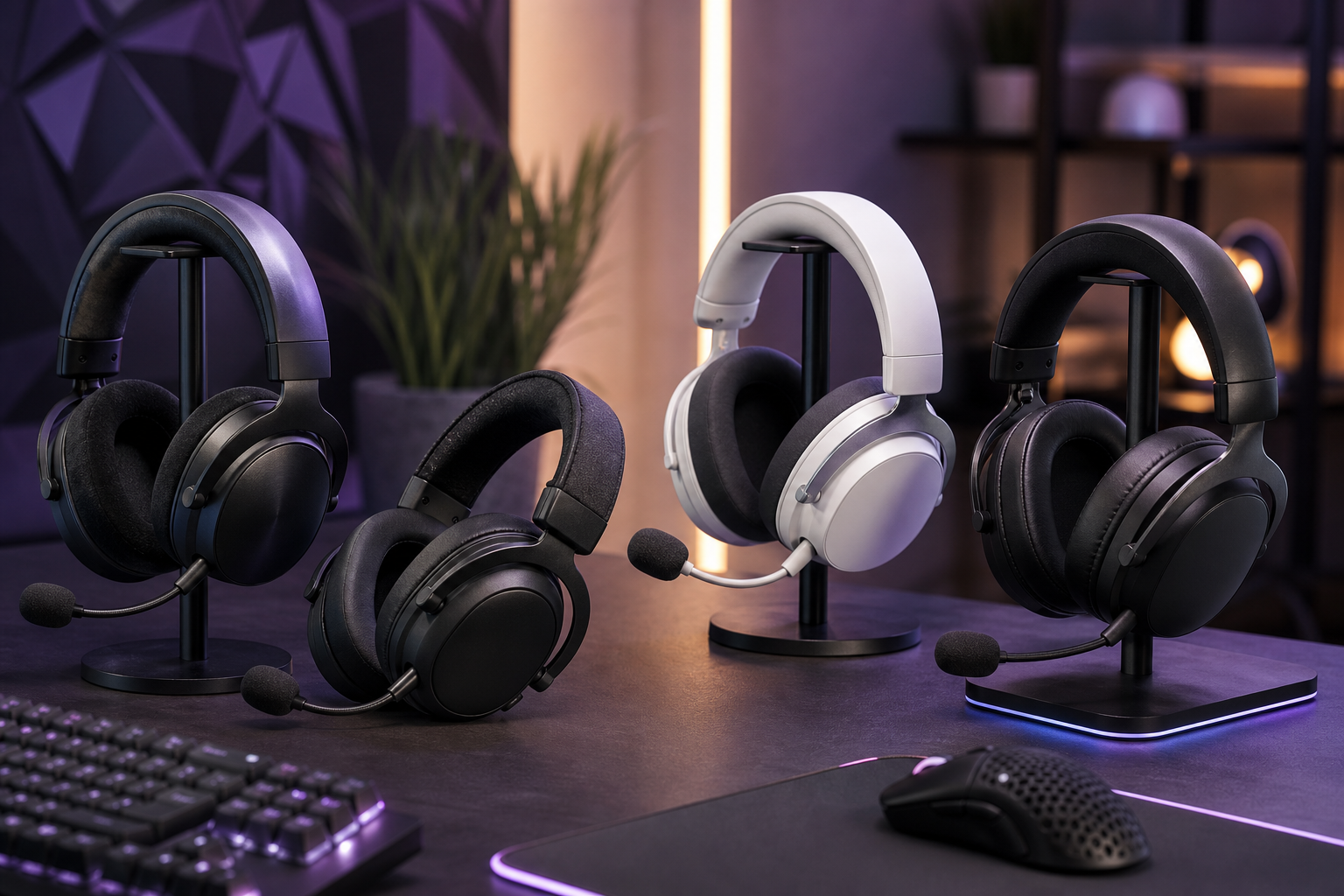
Best Wireless Gaming Headsets in 2026: What Independent Reviewers Actually Say
Six headsets. Sixty-plus combined expert reviews. No single knockout winner — but one model comes closest, and the disagreements between critics are worth knowing before you spend anywhere from $99 to $350.
The Short Version
The Razer BlackShark V3 Pro is the nearest thing to a consensus pick for most gamers in mid-2026. Planar-magnetic enthusiasts and PS5 owners should look at the Audeze Maxwell 2. Multi-platform households with marathon sessions lean toward the SteelSeries Arctis Nova Pro Wireless. Desk-bound PC gamers who want to forget charging exists have the HyperX Cloud Alpha 2 Wireless. None of these cost under $230 — and if $99 is your ceiling, the Turtle Beach Stealth 600 Gen 3 is the budget answer.
The Picks at a Glance
| Headset | Price (MSRP) | Best For | Key Weakness | Sourced From |
|---|---|---|---|---|
| Razer BlackShark V3 Pro | ~$249 | Most gamers — ANC, 10ms wireless, 70h battery | V-shaped tuning; inconsistent mic reviews | TechRadar, Gaming Trend, GamesRadar, Tom’s Hardware |
| Audeze Maxwell 2 | $329.99 | PS5 owners, audiophile-grade audio detail | Weighs 567g; sharp default treble; incremental over original | RTINGS, Game Revolution, CGMagazine, GamesRadar |
| SteelSeries Arctis Nova Pro Wireless | $349.99 | Multi-platform; infinite runtime via hot-swap batteries | Priciest option; ear pads heat up in long sessions | TechRadar, SoundGuys, GamesRadar |
| HyperX Cloud Alpha 2 Wireless | ~$280 | Desk-only PC gamers; 250h claimed battery | Requires base station; no ANC; mediocre mic | Gizmodo, Tom’s Hardware, GamesRadar |
| Logitech G Pro X 2 Lightspeed | ~$230 | Competitive PC gaming; <1ms latency | No ANC; no simultaneous multi-device audio | PCWorld, RTINGS |
| Turtle Beach Stealth 600 Gen 3 | $99 | Budget buyers; 83+ hours battery, multi-platform | High clamping force; loose hinge construction | SoundGuys, PC Gamer |
What the Reviews Agree On
Wireless latency is no longer a real concern
RTINGS, TechRadar, and PCWorld all confirm that 2.4GHz gaming headsets now run below 20ms, and the better ones — the BlackShark V3 Pro at 10ms, the G Pro X 2 Lightspeed at under 1ms — are functionally indistinguishable from wired during play. This was a legitimate debate in 2020. It isn’t now.
ANC has crossed the usefulness threshold
Both the BlackShark V3 Pro and the Arctis Nova Pro Wireless carry active noise cancellation that reviewers consistently describe as functional, not decorative. TechRadar, covering the V3 Pro, called its ANC “one of the easiest recommendations” to bundle into a premium headset purchase. SoundGuys measured the Arctis Nova Pro reducing ambient noise by roughly half in testing — enough for an open-plan room or street traffic. Nobody puts either headset level with Sony’s top consumer ANC. The gap has closed, though.
Battery life has stopped being a concern
The $99 Turtle Beach Stealth 600 Gen 3 exceeded 83 hours in SoundGuys’ measured testing — three hours past Turtle Beach’s own claim. The Arctis Nova Pro Wireless logs 22 hours, 36 minutes per charge and swaps batteries without powering down. The Maxwell 2 claims 80 hours; the Cloud Alpha 2 claims 250. Charging anxiety is largely gone at every price point in this group.
Microphones remain the category’s weakest link
No headset mic here earns glowing marks. Gaming Trend found the BlackShark V3 Pro’s 12mm HyperClear mic clear in gaming contexts but firmly short of streaming quality. Game Revolution called the Maxwell 2’s mic “a cheap add-on” relative to a $329 price tag. SoundGuys describes the Arctis Nova Pro’s retractable mic as engineered for speech intelligibility and nothing beyond it. Multiple outlets land on the same advice: buy a standalone mic if voice quality matters to your setup.
Where They Disagree
Is the Razer BlackShark V3 Pro the best wireless headset, full stop?
TechRadar’s reviewer — citing 14 years of headset testing — called it “one of the easiest recommendations” they could make. Gaming Trend scored it 95/100. GamesRadar praised its audio in a headline as “fantastic audio, premium new features.” Near-consensus. One outlier: Tom’s Hardware titled its review “Highly connected, but you’ll sound worse,” pointing to audio distortion and microphone limitations that the other outlets largely dismiss. The split tracks what each reviewer weighs — TechRadar and Gaming Trend treat the feature stack as the product; Tom’s Hardware isolates audio fidelity under controlled conditions.
Is the Audeze Maxwell 2 a real upgrade or a sidegrade?
Game Revolution awarded it 9/10, citing “unique clarity and separation” from the 8th-generation 90mm planar magnetic drivers. CGMagazine matched that score, calling the audio “clean and full.” RTINGS named it the best PS5 headset they’ve tested. Against that, GamesRadar concluded it “could have done more,” noting the two biggest weaknesses of the original Maxwell — no simultaneous dongle-and-Bluetooth and a heavy build — weren’t fixed. The Maxwell 2 now weighs 567g, up from 490g. Stream Tech Reviews was the bluntest: “Sidegrade, but still Amazing.” If you own the original Maxwell, reviewers run roughly 60/40 against upgrading. Coming from a conventional-driver headset, the audio gap is real and audible.
Does the HyperX Cloud Alpha 2 solve an actual problem?
Gizmodo scored it 3.5/5 and questioned whether a 250-hour battery is meaningful when the headset stays anchored to a base station. Their framing — “Is it truly so agonizing” to charge weekly? — cuts through the marketing. Tom’s Hardware disagrees, emphasizing dual-wireless flexibility and the desktop base station’s six programmable control buttons. The split maps cleanly onto use cases: for a single-desk PC setup, the base station is a feature. For anyone who moves between rooms or wants to take the headset anywhere, it’s a hard constraint. Neither review is wrong; they’re describing different users.
Does the SteelSeries Arctis Nova Pro Wireless justify $100 more than the BlackShark V3 Pro?
TechRadar calls it their personal multi-platform favorite. GamesRadar names it the top Xbox headset. SoundGuys gave it 7.3/10 — respectable, not exceptional — and flagged that a single unit can’t serve PlayStation and Xbox simultaneously. The hot-swap battery system genuinely earns its keep if you regularly run past the 20-hour mark in a week. Below that threshold, paying $100 more than the V3 Pro for features you don’t reach is a harder sell, and multiple reviewers acknowledge it.
The Budget Case: Turtle Beach Stealth 600 Gen 3
One clear answer at $99. SoundGuys measured 83 hours of real-world battery life alongside multi-platform Bluetooth 5.2, customizable EQ through the Swarm II app, and gaming-tuned sound. PC Gamer found the audio “seriously impressive” for the price point. Caveats are physical: the clamping force is stiff enough to cause fatigue past two hours, and the hinge construction feels looser than the chassis suggests. SoundGuys explicitly recommends waiting for a sale before buying at full price.
The Logitech G Pro X 2 Lightspeed sits in an interesting position at ~$230 — no ANC, no simultaneous multi-device audio, but PCWorld praised how the graphene drivers surface subtle environmental detail (ambient audio, spatial cues in RPG environments) that 50mm dynamic drivers in the same tier don’t resolve as cleanly. RTINGS treats it as the competitive PC gaming pick specifically. It earns that label.
FAQ
Does 2.4GHz wireless still lag compared to a wired headset?
Not in any way that registers in gaming. RTINGS and PCWorld both confirm that current 2.4GHz gaming headsets operate below 20ms, and the G Pro X 2 Lightspeed measures under 1ms — faster than most displays can reflect input from the source. The latency argument is settled for gaming use. For professional audio production or music recording, wired remains preferable.
Which wireless headset is the best choice for PS5?
RTINGS names the Audeze Maxwell 2 as their top PS5 pick, based on the planar magnetic sound quality and low-latency connection through the USB-C dongle. The SteelSeries Arctis Nova Pro Wireless is a strong alternative — more features, more platform flexibility, but a less distinctive audio signature. Both work natively with PS5 without extra adapters.
Should original Audeze Maxwell owners upgrade to the Maxwell 2?
Most reviewers say no. GamesRadar and Stream Tech Reviews both reach the same conclusion: the driver technology is similar, the microphone hasn’t improved materially, and the Maxwell 2 is heavier at 567g versus the original’s 490g. The wider headband strap and refined suspension are genuine improvements for comfort in long sessions, but they don’t justify replacing a headset that already sounds excellent. Wait for the Maxwell 3, or a significant price drop.
What is the best wireless gaming headset under $100?
The Turtle Beach Stealth 600 Gen 3 at $99. SoundGuys confirmed 83+ hours of measured battery life, multi-platform Bluetooth 5.2, and adjustable EQ options that let you tune the default bass-heavy profile. Build quality is the trade-off — the hinges are loose and the clamp bites during longer sessions. For the price, nothing else in this roundup competes at that tier.
Sources
- rtings.com
- tomshardware.com
- pcgamer.com
- techradar.com
- gamesradar.com
- soundguys.com
- gamerevolution.com
- gizmodo.com